Friday, July 4, 2025
About Capoeira Angola
Capoeira Angola, a Brazilian martial art that blends dance, acrobatics, and music, deeply rooted in African traditions. Originating in the 16th century, Capoeira was developed by enslaved Africans in Brazil as a means of physical and cultural self-defense.
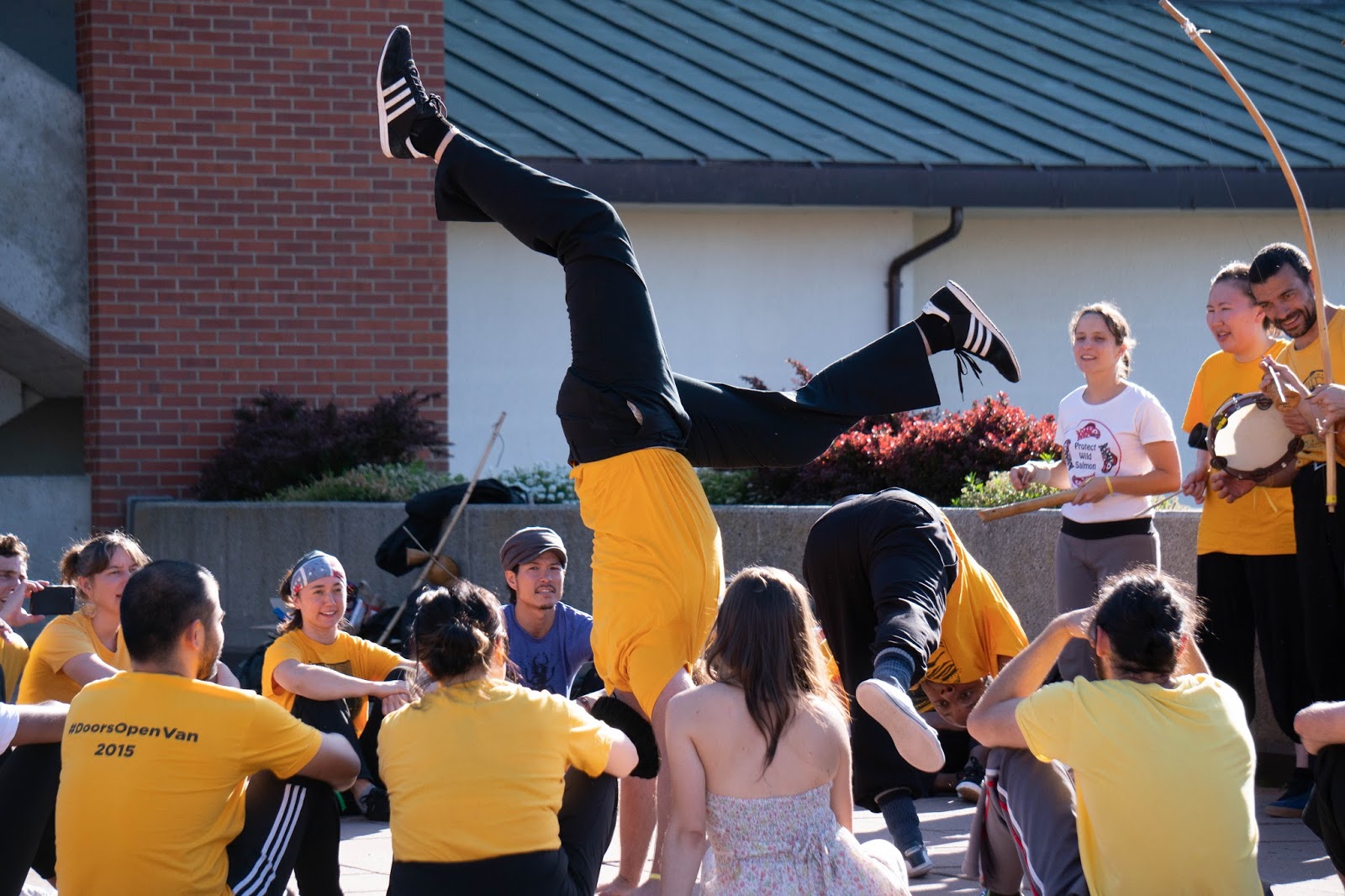
Characterized by fluid, rhythmic movements, Capoeira emphasizes agility, strategy, and improvisation. Practitioners, known as capoeiristas, engage in a playful yet competitive exchange of attacks and evasions within a roda (circle), accompanied by traditional instruments like the berimbau (a single-string percussion instrument), atabaque (drum), and pandeiro (tambourine).
Beyond its physical aspects, Capoeira embodies resistance, resilience, and community, serving as a cultural expression of Afro-Brazilian identity. Over the centuries, it has evolved from an outlawed practice to a celebrated art form recognized worldwide. Today, Capoeira is taught and practiced globally, fostering connections across cultures while preserving its rich heritage.
In Bellingham, classes are taught by Matteo Tamburini, student of Mestre Silvinho. Matteo has been practicing Capoeira for over 15 years and was recognized as a Treinel (one who has the capacity to teach) at the 2019 International Capoeira Angola Foundation conference.
Characterized by fluid, rhythmic movements, Capoeira emphasizes agility, strategy, and improvisation. Practitioners, known as capoeiristas, engage in a playful yet competitive exchange of attacks and evasions within a roda (circle), accompanied by traditional instruments like the berimbau (a single-string percussion instrument), atabaque (drum), and pandeiro (tambourine).
Beyond its physical aspects, Capoeira embodies resistance, resilience, and community, serving as a cultural expression of Afro-Brazilian identity. Over the centuries, it has evolved from an outlawed practice to a celebrated art form recognized worldwide. Today, Capoeira is taught and practiced globally, fostering connections across cultures while preserving its rich heritage.
In Bellingham, classes are taught by Matteo Tamburini, student of Mestre Silvinho. Matteo has been practicing Capoeira for over 15 years and was recognized as a Treinel (one who has the capacity to teach) at the 2019 International Capoeira Angola Foundation conference.
I am humbled to be entrusted with this responsibility, and in my role as caretaker I do my best to teach what Mestre Silvinho has taught me, while continuing to deepen my own understanding and learning.
Capoeira has changed my life for the better in radical ways, and it has helped me reconnect with my own ancestral roots in Italy and Ireland, as well as informed my understanding of my place in a profoundly racist society such as our own.
Thursday, August 27, 2020
An echo of the past: Bellingham's oldest remaining Berimbau?
I have heard rumors that there was some organized Capoeira in Bellingham before the beginning of its current incarnation with Ben Lockwood, Holly Polinkus and Elese Watness back in the fall of 2007. Maybe even before Skya Fisher moved to Bellingham in 2002 and taught a class at the YWCA.
For example, a friend recalled a Capoeira demonstration at Ferndale High School in the early 2000s.
But there was no evidence left, only vague hearsay - until now:
A friend lives at the Oasis community house in Bellingham, and told me that there was a berimbau lying around. We finally connected and I was able to retrieve it.
The berimbau itself definitely needed some love: I replaced the leather cap at the top, healed a crack in the cabaca with some wood glue... but it's still useable! And now it finally has a home where it can hang and relax.
Who used to own this berimbau? My friend has heard that it was someone whose name was possibly Jason, a previous resident of the Oasis, who practiced Capoeira.
Who was this person? what kind of Capoeira did they train? who did they train with? who was their teacher? when were they training? (for reference, Mestre Jurandir came to Seattle at the invitation of Charles Hargrett in 1997) who made the berimbau? what kind of wood is it?
Labels:
photos
Monday, August 3, 2020
The pandemic and the BREATHE act.
Well, obviously we are not training indoors at the moment, or in the foreseeable future. We are doing some physically distanced outdoor music and movement.
Movement: of our bodies, and for Black Lives and our collective liberation. Check out the BREATHE act.
The roda teaches us that to get anything done we need to act collectively; that our relationships matter; that we should listen and learn from one another. Can we take those skills into the roda of life?
‘Dentro da boca fechada
mosca nunca vai entrar’
é um ditado
do meu povo
que sabe que nada vai mudar.
Capoeira nos ensina
pra mudar realidade
uma voz nao adianta nada
so com a coletividade.
O calado é vencedor,
assim diz velho ditado,
se os calados se juntarem
mundo vai ser derrubado!
Labels:
ladainha,
the struggle isn't over
Sunday, February 2, 2020
Black History Month 2020
Among the many suggestions for reading and reflection that could be shared, I have recently been struck by the project Songs of our native daughters.
The liner notes can be downloaded for free from the smithsonian, and they are a fantastic resource.
Much like another recording from the Smithsonian Folways, Capoeira Angola: from Salvador Brasil by Grupo de Capoeira Angola Pelourinho, whose liner notes can also be downloaded for free.
This is a video with some reflections from the four women who participated in the project Songs of our native daughters.
The liner notes can be downloaded for free from the smithsonian, and they are a fantastic resource.
Much like another recording from the Smithsonian Folways, Capoeira Angola: from Salvador Brasil by Grupo de Capoeira Angola Pelourinho, whose liner notes can also be downloaded for free.
This is a video with some reflections from the four women who participated in the project Songs of our native daughters.
And this is a video of GCAP from 1991 - a classic!
Monday, December 30, 2019
Monday, June 3, 2019
Anecdotes
I wrote the following shortly after last year's Afro-Brasilian Festival. It was published in the March 2019 issue of Whatcom Watch., after a couple of unsuccessful attempts to get it published in the Western Front.
Anecdotes should not be used to decide public policy.
I’ll include a few examples:
Two friends from out of town were pulled over by the police. They were looking for my place in the late evening, and possibly driving a little hesitantly, as you might in an unfamiliar residential neighborhood in the dark.
One of them, the passenger, is an African American. He was in town from Washington, D.C., and was going to lead a workshop at WWU the next morning.
I am white. I spent at least 10 minutes earlier that same night parking in someone else’s driveway, then “scouting” the exterior of two nearby homes, climbing up their front steps, entering one of their backyards. I did all of this undisturbed by the police, and any of the neighbors.
Even multiple anecdotes do not prove anything.
My teacher was walking across the WWU campus one afternoon. He had a long, unusual bag slung over his shoulder, and had his hood up. Campus police stopped and questioned him. Oh, he is Black.
I walk across the WWU campus with a similar bag multiple times a week. Often people ask me if it contains a fishing pole, or a bow and arrows. The police never have. (Side fact: the overwhelming majority of campus shooters is white — just like me!)
Anecdotes from the past should not be used to decide public policy today because things have changed.
On February 15, 2007, some students protested the presence of military recruiters at a WWU career fair. The conversation got a little heated. One of the students was arrested, the only student who was visibly non-white. (A side note: the director of the Viking Union at the time described himself as “the de facto champion of free expression on campus.”)
Anecdotes from the past definitely should not suggest to us that they reveal a trend — only hard facts can do that.
I also protested military recruiters at a WWU career fair, more than once. On two separate occasions, I was even asked to leave by some police officers, but I was not arrested.
People Being Killed
Anecdotes like the shooting of many unarmed African-American men and women by police officers certainly do not define every individual interaction between African-American people and police officers, when they are pulled over (like Philando Castille, who was murdered in July 2016), or even just lying down in the street with their hands in the air (like Charles Kinsey, who told police that he was a behavioral therapist caring for the autistic patient who sat next to him, and was shot in the leg, also in July of 2016). And anyway, instances of people of color being killed by police happen in other places, certainly not in Bellingham.
Well, except for Manuel Gonzales, killed on Railroad Avenue in March of 2017 by a Bellingham Police Department officer.
So my friend from D.C., who was pulled over, or my teacher walking across campus with his oversized bag, should not have instinctively drawn on the wealth of anecdotes about such situations, and should have directed their minds to feel perfectly comfortable, and, in fact, welcome, in the city we call home.
So what are anecdotes good for?
Anecdotes COULD cause us to challenge some of the unspoken narratives that we hold. Or they might cause us to re-examine some events in a new way. Or hearing an anecdote from someone we know might cause us to hear and believe stories from other people’s lives. Our brains are funny like that, sometimes hearing a story from someone we can relate to impacts us more than the same story told by someone else — even if the connection to the storyteller is only skin deep (though buried under that tenuous connection are all of the assumptions about sameness and difference that we inherit from a legacy of hatred and violence that began when Christopher Columbus initiated a policy “that resulted in complete genocide” on Hispaniola, in the words of Harvard historian Samuel Eliot Morrison).
Okay, one last anecdote.
Stop me if you’ve heard this one before. You see, I studied math at WWU, and got paid while in graduate school to be a TA (teacher’s assistant). Some of the professors would structure their classes along the lines of the “Moore method” for teaching mathematics. The teachers never mentioned that “Moore” was Robert Lee Moore (1882 – 1974), a mathematics professor whose bigotry led him to refuse to allow African-American students into his classes, or to tell them “you are welcome to take my course, but you start with a C and can only go down from there.” (I should clarify that the “Moore method” for teaching mathematics used by my professors did NOT entail actively antagonizing students of color.) Editor’s Note: Robert Lee Moore taught at a number of schools, but not in Bellingham. He taught at the University of Texas in Austin from 1920 until 1969.
See, this is where anecdotes could lead me astray. I might jump to the conclusion that Moore was not alone, and that the widespread discrimination within academia against African-American students (and others), particularly in mathematics, has added up to a situation in which the competition for the position that paid for my graduate studies was not particularly fierce, because a whole group of people has been actively pushed out of the field. I might conclude that I, a white person, benefit financially over the course of my whole lifetime from other people’s oppression. And anecdotes aren’t enough evidence to prove that something like that is true.
No, we would need to decide to invest some time and do some serious research, such as reading the amicus curiae brief of the American Sociological Association to the Supreme Court in the Grutter vs. Bollinger case, to name one possible source. But hey, who has time for that, right?
Let me tell you about the time …
___________________________________
Matteo Tamburini earned a master’s degree in Mathematics from WWU in 2009. He has been teaching (and learning) mathematics at Northwest Indian College, and studying the Afro-Brasilian artform Capoeira Angola, both since 2009. Matteo serves on the board of the Whatcom Peace & Justice Center.
Anecdotes should not be used to decide public policy.
I’ll include a few examples:
Two friends from out of town were pulled over by the police. They were looking for my place in the late evening, and possibly driving a little hesitantly, as you might in an unfamiliar residential neighborhood in the dark.
One of them, the passenger, is an African American. He was in town from Washington, D.C., and was going to lead a workshop at WWU the next morning.
I am white. I spent at least 10 minutes earlier that same night parking in someone else’s driveway, then “scouting” the exterior of two nearby homes, climbing up their front steps, entering one of their backyards. I did all of this undisturbed by the police, and any of the neighbors.
Even multiple anecdotes do not prove anything.
My teacher was walking across the WWU campus one afternoon. He had a long, unusual bag slung over his shoulder, and had his hood up. Campus police stopped and questioned him. Oh, he is Black.
I walk across the WWU campus with a similar bag multiple times a week. Often people ask me if it contains a fishing pole, or a bow and arrows. The police never have. (Side fact: the overwhelming majority of campus shooters is white — just like me!)
Anecdotes from the past should not be used to decide public policy today because things have changed.
On February 15, 2007, some students protested the presence of military recruiters at a WWU career fair. The conversation got a little heated. One of the students was arrested, the only student who was visibly non-white. (A side note: the director of the Viking Union at the time described himself as “the de facto champion of free expression on campus.”)
Anecdotes from the past definitely should not suggest to us that they reveal a trend — only hard facts can do that.
I also protested military recruiters at a WWU career fair, more than once. On two separate occasions, I was even asked to leave by some police officers, but I was not arrested.
People Being Killed
Anecdotes like the shooting of many unarmed African-American men and women by police officers certainly do not define every individual interaction between African-American people and police officers, when they are pulled over (like Philando Castille, who was murdered in July 2016), or even just lying down in the street with their hands in the air (like Charles Kinsey, who told police that he was a behavioral therapist caring for the autistic patient who sat next to him, and was shot in the leg, also in July of 2016). And anyway, instances of people of color being killed by police happen in other places, certainly not in Bellingham.
Well, except for Manuel Gonzales, killed on Railroad Avenue in March of 2017 by a Bellingham Police Department officer.
So my friend from D.C., who was pulled over, or my teacher walking across campus with his oversized bag, should not have instinctively drawn on the wealth of anecdotes about such situations, and should have directed their minds to feel perfectly comfortable, and, in fact, welcome, in the city we call home.
So what are anecdotes good for?
Anecdotes COULD cause us to challenge some of the unspoken narratives that we hold. Or they might cause us to re-examine some events in a new way. Or hearing an anecdote from someone we know might cause us to hear and believe stories from other people’s lives. Our brains are funny like that, sometimes hearing a story from someone we can relate to impacts us more than the same story told by someone else — even if the connection to the storyteller is only skin deep (though buried under that tenuous connection are all of the assumptions about sameness and difference that we inherit from a legacy of hatred and violence that began when Christopher Columbus initiated a policy “that resulted in complete genocide” on Hispaniola, in the words of Harvard historian Samuel Eliot Morrison).
Okay, one last anecdote.
Stop me if you’ve heard this one before. You see, I studied math at WWU, and got paid while in graduate school to be a TA (teacher’s assistant). Some of the professors would structure their classes along the lines of the “Moore method” for teaching mathematics. The teachers never mentioned that “Moore” was Robert Lee Moore (1882 – 1974), a mathematics professor whose bigotry led him to refuse to allow African-American students into his classes, or to tell them “you are welcome to take my course, but you start with a C and can only go down from there.” (I should clarify that the “Moore method” for teaching mathematics used by my professors did NOT entail actively antagonizing students of color.) Editor’s Note: Robert Lee Moore taught at a number of schools, but not in Bellingham. He taught at the University of Texas in Austin from 1920 until 1969.
See, this is where anecdotes could lead me astray. I might jump to the conclusion that Moore was not alone, and that the widespread discrimination within academia against African-American students (and others), particularly in mathematics, has added up to a situation in which the competition for the position that paid for my graduate studies was not particularly fierce, because a whole group of people has been actively pushed out of the field. I might conclude that I, a white person, benefit financially over the course of my whole lifetime from other people’s oppression. And anecdotes aren’t enough evidence to prove that something like that is true.
No, we would need to decide to invest some time and do some serious research, such as reading the amicus curiae brief of the American Sociological Association to the Supreme Court in the Grutter vs. Bollinger case, to name one possible source. But hey, who has time for that, right?
Let me tell you about the time …
___________________________________
Matteo Tamburini earned a master’s degree in Mathematics from WWU in 2009. He has been teaching (and learning) mathematics at Northwest Indian College, and studying the Afro-Brasilian artform Capoeira Angola, both since 2009. Matteo serves on the board of the Whatcom Peace & Justice Center.
Labels:
the struggle isn't over
Tuesday, May 14, 2019
Gratidao
Words cannot adequately express the immense gratitude and joy that this event brought.
What an amazing opportunity to learn from Mestre Cobra Mansa!
Thanks to the leadership and ongoing support from Mestre Silvinho!
and as always, what makes this day so special are all the visits from our friends, old and new, from Vancouver, Seattle, Portland and points in between!
And thanks for Treinel Caxambu and Treinel Joe (all the way from Hawaii!)
The photos below were taken by Jason Ruvelson. Thank you!
What an amazing opportunity to learn from Mestre Cobra Mansa!
Thanks to the leadership and ongoing support from Mestre Silvinho!
and as always, what makes this day so special are all the visits from our friends, old and new, from Vancouver, Seattle, Portland and points in between!
And thanks for Treinel Caxambu and Treinel Joe (all the way from Hawaii!)
The photos below were taken by Jason Ruvelson. Thank you!
![]() |
| Mestre Cobra Mansa |
![]() |
| the beginning of our roda in the PAC plaza |
![]() |
| essa cobra lhe morde, senhor sao bento! |
![]() |
| ter sorriso no rosto, e' coisa de angoleir@ |
![]() |
| pedo a forca da terra, pedo a forca do ar! |
![]() |
| Obrigado minha gente! |
Labels:
Mestre Cobra Mansa,
Mestre Silvinho,
photos
Monday, April 22, 2019
It's time again: Afro-Brasilian Festival 2019!
Sunday May 5th!
The event will be heald in Carbery Gym, Gym C (upstairs). Please, no street shoes in the Gym!
Cost of admission is $10 per person per class, or $30 for the entire day (we'll give discounts to families, and no-one will be turned away).
And this year, we have a super-special guest in Mestre Cobra Mansa!
11am: Capoeira class with the Mestres - for complete beginners as well as intermediate-advanced people.
1pm: lunch break
2pm: Salsa Class with Antonio Diaz
3pm: Class with the Mestres
4pm: Roda! (if the weather is nice, we'll be outside in the PAC plaza).
Labels:
Mestre Cobra Mansa,
Mestre Silvinho,
photos
Sunday, October 14, 2018
Tragedy
Mestre Moa do Katende was murdered in Salvador on Sunday October 7th.
He was stabbed twelve times by a supporter of Brasilian Presidential candidate Jair Bolsonaro, after the two had a disagreement about politics. Mestre Moa had supported a different candidate.
A tremendous loss. One more Black man victim of racism and intolerance.
He was stabbed twelve times by a supporter of Brasilian Presidential candidate Jair Bolsonaro, after the two had a disagreement about politics. Mestre Moa had supported a different candidate.
A tremendous loss. One more Black man victim of racism and intolerance.
Friday, October 5, 2018
Indigenous People's Day 2018
I suggest reading Loaded: a disarming history of the second amendment, by Roxanne Dunbar Ortiz, which i recently borrowed from the library of the Whatcom Peace and Justice Center.
It includes the following two quotations:
So if ever built, what will the United States Native American Genocide Memorial Museum contain: What will it exhibit?
It will be one room, a fifty-foot square with the same large photo filling the walls, ceiling and floor.
There will be only one visitor allowed at any one time.
There will be no furniture.
The one visitor will have to stand or sit on the floor.
Or lie on the floor if they feel the need.
That visitor must remain in that room for one hour.
There will be no music.
The only soundtrack will be random gunshots from rifles used throughout American history.
Reverberation.
What will the photo be?
It will be an Indian baby, shredded by a Gatling gun, lying dead and bloody in the snow.
It includes the following two quotations:
So if ever built, what will the United States Native American Genocide Memorial Museum contain: What will it exhibit?
It will be one room, a fifty-foot square with the same large photo filling the walls, ceiling and floor.
There will be only one visitor allowed at any one time.
There will be no furniture.
The one visitor will have to stand or sit on the floor.
Or lie on the floor if they feel the need.
That visitor must remain in that room for one hour.
There will be no music.
The only soundtrack will be random gunshots from rifles used throughout American history.
Reverberation.
What will the photo be?
It will be an Indian baby, shredded by a Gatling gun, lying dead and bloody in the snow.
Sherman Alexie, from You don't have to say you love me
In 1818, President James Monroe ordered Andrew Jackson, by then a major general in the U.S. Army, to lead three thousand soldiers into Florida, at the time part of the Spanish empire, to crush the Muskogee-led Indigenous Seminole guerrilla resistance. The Seminoles did not agree to hand over any Africans who had escaped from their enslavers.
As we reflect on this history of colonial violence, which is a part of learning Capoeira, we are also called to action. Indigenous writer Rebecca Nagle wrote a piece in Indian Country Today urging us to demand that the clothing company Yandy cancel its line of 'sexy' 'native' costumes.
Similarly, there is a small campaign here in Bellingham to ask that WECU reconsider officially recognizing Columbus Day in its mailings, calendars, and general communications with the public, and instead identify it as Indigenous People's Day.
WECU's contacts are:
Contact Center Hours: Monday-Friday, 8:00am – 6:00pm
Local: 360-676-1168
Toll Free: 800-525-8703
Fax: 360-756-7800
TTY: 800-833-6388
Local: 360-676-1168
Toll Free: 800-525-8703
Fax: 360-756-7800
TTY: 800-833-6388
Sunday, September 30, 2018
Back to school in 2018
WWU is back in session!
we'll be training on Mondays starting at 6pm in the Viking Union, room 464. take the elevator to the 4th floor and go to the end of the hallway.
We will also be training on Thursdays starting at 6pm in PAC room 24. From the main entrance, take the elevator down to LL2. Room 24 is directly across from the elevator.
we'll be training on Mondays starting at 6pm in the Viking Union, room 464. take the elevator to the 4th floor and go to the end of the hallway.
We will also be training on Thursdays starting at 6pm in PAC room 24. From the main entrance, take the elevator down to LL2. Room 24 is directly across from the elevator.
![]() |
| Roda at the 2018 Afro-Brasilian Festival. Photo Credit: Eythan Frost. There will be warm weather and long days again! and we'll be ready play outside. |
Labels:
ContraMestre Kojo,
Mestre Silvinho,
photos
Sunday, May 13, 2018
Thank you is just not enough
Another year, another time in which words fail us to express our appreciation, admiration, and respect for the many people involved in putting on the Afro-Brazilian Festival.
First of all, we start with the acknowledgement that we are learning this artform on the ancestral land of the Lummi and Nooksack people - may we always struggle to live in right relationship with the original inhabitants of this land.
Thanks to all the people who struggled to make Capoeira survive, among them Mestre Silvinho and ContraMestre Kojo. And a special shout-out to Charles Hargrett, for starting all of this in the Pacific Northwest back in 1996, and for being a great example for us all.
Thank you to Amanda, Leika, Rena and Bill for an amzing evening on Friday learning about the connections between sugar, colonialism, food, and our present condition of health disparities.
Thanks to all the people who worked behind the scenes to work with WWU to make this happen, to make the poster [design by Rosanna Razor], to provide the food, to pick up the chairs and tables...
Thank you to the amazing teachers - Manimou Camara and Jade Power Sotomayor (and friends, and family) - who gave up a part of their weekend to come to Bellingham and share their art with us.
And thanks to all the Angoleir@s who travelled near and far to join us from Vancouver (BC), Seattle, Portland and Corvallis (OR), and one new friend from Xalapa (Mexico)! Your presence, your energy, renew our belief in the power of Community.
"Capoeira Angola is working on 'self' and building 'community' in the process!" -CM KOJO
First of all, we start with the acknowledgement that we are learning this artform on the ancestral land of the Lummi and Nooksack people - may we always struggle to live in right relationship with the original inhabitants of this land.
Thanks to all the people who struggled to make Capoeira survive, among them Mestre Silvinho and ContraMestre Kojo. And a special shout-out to Charles Hargrett, for starting all of this in the Pacific Northwest back in 1996, and for being a great example for us all.
Thank you to Amanda, Leika, Rena and Bill for an amzing evening on Friday learning about the connections between sugar, colonialism, food, and our present condition of health disparities.
Thanks to all the people who worked behind the scenes to work with WWU to make this happen, to make the poster [design by Rosanna Razor], to provide the food, to pick up the chairs and tables...
Thank you to the amazing teachers - Manimou Camara and Jade Power Sotomayor (and friends, and family) - who gave up a part of their weekend to come to Bellingham and share their art with us.
And thanks to all the Angoleir@s who travelled near and far to join us from Vancouver (BC), Seattle, Portland and Corvallis (OR), and one new friend from Xalapa (Mexico)! Your presence, your energy, renew our belief in the power of Community.
"Capoeira Angola is working on 'self' and building 'community' in the process!" -CM KOJO
![]() |
| Roda at the closing of morning class in Carver Gym Photo Credit: Eythan Frost from the AS Review |
| CM Kojo leading music class in Red Square |
![]() |
| Roda in the PAC plaza. Photo credit to Camila Hellmeister |
![]() |
| Photo credit to Camila Hellmeister |
![]() |
| Photo Credit: Eythan Frost from the AS Review |
![]() |
| Photo Credit: Eythan Frost from the AS Review |
Tuesday, April 17, 2018
2018 Afro-Brasilian Festival!
Mark your calendars!
Saturday May 12th, in WWU's Carver Gym!
10 to 12am: Capoeira Angola class with Mestre Silvinho and ContraMestre Kojo;
1 to 2pm: Puerto Rican Bomba class with Jade Power Sotomayor;
2:15 to 3:15: concurrent west African drumming class with Manimou Camara and berimbau class with ContraMestre Kojo;
3:30 to 4:30: West African Dance class with Manimou Camara;
4:45 to ... : Capoeira Angola Roda
Free for students! $5 per class for the general public.
>Many thanks to:
WWU Music Department
WWU Dance Department
WWU Anthropology Department
AS Activities Fund
Community Food Co-op
Whatcom Peace and Justice Center
and the many, many people who help make this possible!dit:
Saturday May 12th, in WWU's Carver Gym!
10 to 12am: Capoeira Angola class with Mestre Silvinho and ContraMestre Kojo;
1 to 2pm: Puerto Rican Bomba class with Jade Power Sotomayor;
2:15 to 3:15: concurrent west African drumming class with Manimou Camara and berimbau class with ContraMestre Kojo;
3:30 to 4:30: West African Dance class with Manimou Camara;
4:45 to ... : Capoeira Angola Roda
Free for students! $5 per class for the general public.
![]() |
| Mestre Silvinho! Photo credit: photoyozee |
WWU Music Department
WWU Dance Department
WWU Anthropology Department
AS Activities Fund
Community Food Co-op
Whatcom Peace and Justice Center
and the many, many people who help make this possible!dit:
Labels:
ContraMestre Kojo,
Mestre Silvinho,
photos
Sunday, January 21, 2018
Thursday, November 16, 2017
Novermber 20th: The day of Black Awareness
Organization in Brasil have been celebrating November 20th as the day of Black Awareness since the 1960s (in 2003, it became a national holiday).
The date, November 20th, was chosen to commemorate the death of Zumbi, one of the icons of resistance against slavery in Brasil. Zumbi was the last leader of the Kilombo (or Quilombo) of Palmares, a community of over 10,000 people (at its peak) that resisted incursions by the Portuguese for over 80 years. More recently, people have also been focusing on the figure of Dandara. Zumbi was Dandara's husband. She is understood to have participated in the defense of Palmares both by helping the plans and by fighting directly with against the Portuguese Army.
To commemorate this day, we'll read an abridged version of the document below.
The Gunga: a Griot instrument to connect with the Ancestors st 2017
The date, November 20th, was chosen to commemorate the death of Zumbi, one of the icons of resistance against slavery in Brasil. Zumbi was the last leader of the Kilombo (or Quilombo) of Palmares, a community of over 10,000 people (at its peak) that resisted incursions by the Portuguese for over 80 years. More recently, people have also been focusing on the figure of Dandara. Zumbi was Dandara's husband. She is understood to have participated in the defense of Palmares both by helping the plans and by fighting directly with against the Portuguese Army.
To commemorate this day, we'll read an abridged version of the document below.
FROM WIKIPEDIA: A griot is a West
African historian, storyteller, praise singer,
poet and/or musician. Griots are a repository of oral tradition and are often seen as a societal leader due to
their traditional position as advisors to royalty. According to the book Savannah
Syncopators, "Though [griots] have to know many traditional songs
without error, they must also have the ability to extemporize on current
events, chance incidents and the passing scene. Their wit can be devastating
and their knowledge of local history formidable". Although they are
popularly known as "praise singers", griots may use their vocal
expertise for gossip, satire, or political comment.
Once I read that in past, in the seventeen and
eighteen hundreds, one of capoeiristas favorite pastimes, aside from
challenging the police and showing the elites who should fear and respect who,
was to climb up on bell towers and ring the bells. Some interpreted this very
dangerous behavior (which resulted in grave accidents and even death) as purely
exhibitionism, like the behavior of a street child. It was more than this.
Street kids, who love exhibitionism, were enchanted by the capoeiristas and
considered them almost superhuman. The capoeiristas reputation and their aura
of invincibility made them the stuff of legends. Add their in their elegance,
their smooth behavior, their easy smile always on their face, their
incomparable cunning, their mandinga, and their “closed body”, and you can see
how they would easily be described as godlike. The racist society in which they
lived however painted them as devils. And this portrayal as devils is what has
been sustained in the history books. We get fuller picture of why capoeiristas
were considered supernatural beings when we consider that their exhibitionism
pushed them to often would demonstrate their abilities in public. It’s
interesting that, whether they were considered half-god or half-devil, they
were perceived as more than human.
But let’s focus on the bell. A bell is an
instrument to tell the official time. Those who control the bells are those who
have the power to announce the important moments to the entire group. The
Church, which the official institutions in Brasil recognize as the
representative of God’s will, holds the monopoly over bells that keep time
publicly. Having bells means having power. And capoeiristas like to give
demonstrations of power. Therefore, in the same way in which they went to
subvert the public order by challenging the elites, in the same way in which
they challenged the police over the definition of public order, they took on
the power to tell the time and they made the bells ring. In a structure that
was designed to make them the least important people in society, they would
laugh in everyone’s face and make themselves the most prominent. The dominant
social institutions wished to stomp on their head, they placed themselves in a
position of power. Capoeira is an exercise in self-determination, in freedom.
And for Black people, freedom cannot be exercised without daring, without
subversion. Black folks were not born to follow rules – we were born to break
them. Because the reality is that in Brasil [and in the United States], rules
were made against us, they were designed to oppress us, capture us, kill us.
Look at the statistics about mass incarceration, poverty, vote suppression,
police brutality. Those who believe that this was true in the past, but no
longer, are fooling themselves. The need to challenge society’s norms is still
present. Challenging the structure is Black people’s law. We can only exist so
long as we continue this challenge.
Once again, let’s leave the conversation about
the essence of Capoeira to the side for a moment and focus on the bell. The
bell has the power to capture people’s attention and to announce that the time
has come. The bell signals the moment of connection. When church bells ring,
they remind people of God, of spirituality. Many [catholic] people do the sign
of the cross. Church bells announce the beginning of Mass. It is almost
impossible to remain indifferent to the sound of a bell, even for those who
were not raised in the Christian faith.
The berimbau has the same properties, it fulfills all of these function.
The berimbau captures people’s attention, no-one can ignore it, people crane
their necks to see what it is. The word gunga itself, which comes from the
Bantu languages, means “bell”. And if the berimbau is our bell, then the roda
is our Mass.
The Gunga bears the voice. The Gunga is king.
The Gunga is God. The Gunga is the one who controls the roda. It calls some
people to come to “Mass”, and it invokes the ancestors to the ritual. It
announces the time to meet our ancestors, to work on our spirituality. The Gunga
holds great power. In our current society, this power is being suffocated, just
like the power to challenge the system is being suffocated. Our society
obscures the fact that Black people are descendants of great civilizations, of
glorious lineages of kings and queens. Whiteness hides anything that might
bring pride or power to Black people. If today we don’t identify all of the
greatness that exists in Black people and in Capoeira, this is because of the
culture of whiteness. Some people believe that Black Brasillians are
‘descendants of slaves’ and that Capoeira is only a form of street fight. They
want us to believe that they are the ones who freed the slaves, and freed
Capoeira from the clutches of street thugs. They sell the idea that Black
people should be happy with their current conditions because ‘things were much
worse.’ This is how it works: choose the worst possible term of comparison, and
everything can be portrayed as an improvement. We should distrust every part of
this official narrative, and look beyond the curtain. Our mission should be to
subvert this narrative. We must refer to what Black people had before the
intervention of whiteness in history.
See what power there is in being the bearer of
history, the holder of the voice. In Capoeira, the Gunga is the one that tells
our stories, the guardian of the voice. The Gunga is power. The person who
receives the Gunga holds – or should hold – the role of the griot. The oral
tradition is fundamental, because the griot’s voice carries history. Words form
a connection that is the basic principle of connection to the ancestors, to
spirituality. Words are Axé. They connect us to one another, to the future, to
the past, to the entire world… If you close your eyes an think to griots
fulfilling their duties, using the instrument called kora, which also has
certain similar features to a berimbau, you get an image similar to a roda, in
which the person with the Gunga is in the center, as a reference to all the
others. Our society however wants to leave this correspondence between the
Gunga and the griot in the past. The oral tradition is neglected. It’s common
these days, at the end of the roda, to simply acknowledge the Mestres and
guests who are present and to list upcoming events. No history. It almost seems
like a commercial, and it is, in some ways. But it should be a commercial for
our history, which has few other means to be spread in our society.
The death of the oral tradition is the killing
of Capoeira itself. Killing the griot means breaking the main channel for the
distribution of the oral tradition. This is one of the main reasons why
Capoeira has been growing further away from its origins. This is in large part
a reflection of the process of whitening. When we pass the Gunga and Capoeira
itself to someone who represents the opposite of the history of Capoeira, the
roda serves an opposite purpose. Without an intense amount of previous work,
white people don’t have the minimum prerequisites to fulfill this role. First,
because the history of Black people is erased by society’s institutions. Since
this is the case, without having an interest and expending great effort, it
cannot be accessed. And how can you tell a story that you don’t know? Secondly,
because the “official” history of white people, (the ‘master narrative’ of
history) is taught and reinforced everywhere. Even if they wanted to talk about
their history, what would there be to talk about? There is no need for a griot
to tell the “official” master narrative of history for white people. Even more
than this, the stories told by a griot would denounce and challenge the master
narrative of history, calling into question the narrative that “I deserved what
I worked for, no-one gave me anything”. The society would be confronted with
the huge historical debts that it owes to Black people and Indigenous people,
among others. This is reason enough why whiteness must erase those stories.
Therefore the function of griot in Capoeira gets set aside, because this is how
whiteness works: it promotes the idea that you should take what you like, and
eliminate the rest.
However, Black culture cannot allow this, it
is fundamentally holistic. Either you respect everything or you have nothing.
We are taught that, when you enter into someone’s home, we behave according to
the norms of that home. For those who are respectful, you dress in white on the
days in which you are expected to dress in white. It doesn’t matter if you feel
better wearing other colors. It is necessary to make sacrifices to be part of a
community. If you only follow the community when it is entirely convenient to
you, then the community serves you and not the other way around. The community
establishes a relationship of solidarity and you don’t reciprocate. It is
necessary to learn how to sacrifice in order to maintain the tradition. Imagine
if each individual demanded that a community adapt to each of their personal
preferences. Things would get lost – there would be no essence preserved.
Identities would disappear. A culture of resistance is a culture of
preservation. We have to make an effort for a community, give this respect. The
community decides the direction, and the individual should accept the decision.
This doesn’t mean to lose oneself entirely, but find one’s place. This is the
meaning of the word ubuntu.
The problem is that there is a radical
difference between Black culture and the culture of whiteness. Individual white
people are not the problem. The problem is the culture that they learn. They
must re-educate themselves. Their individualism is in direct opposition to a
sense of community. Whiteness, colonialism and capitalism push people to use
and discard, to exploit the resources, exhaust them, and leave. To take the
parts you like and throw away the rest. Once you begin to operate like that
with Capoeira or with any other cultural artform, you change its essence.
Imagine someone asking for a bacon cheeseburger without bacon and without
cheese.
Without a griot, without an oral tradition,
you close the channel to the ancestors. Without ancestrality, there can be no
Black culture – if for no other reason that without the ancestors we wouldn’t
be here, neither ourselves nor our culture. Therefore we have to reestablish
the link Gunga-griot-oral tradition-ancestors. The Gunga is a responsibility –
a big responsibility. Being the bearer of the voice is not for everyone. The
bearer of the voice cannot remain silent. The bearer of the voice must share
this voice. How can you use the Gunga to call everyone together, those here and
those who have passed on, and not complete the connection? Let us cultivate the
oral tradition – it is the basic element. This is for everyone, both for Black
people and for white people. However, white people have to be extremely more
careful since, as I said above, they did not grow up in this culture and in
fact were exposed to the opposite values. Beyond this, they bear some
historical debts that they should stop trying to avoid, most of all if they
wish to participate in Black culture and be among Black people without being in
the way.
Starting from the moment in which we give the
berimbau in a white person’s hand without guaranteeing that they have
understood the function of a griot, and that they have taken up the
responsibility that it entails, starting from the moment in which we give them
the power to tell our stories, we are setting ourselves up for the loss of some
things. However, it’s worth remarking on the fact that we don’t do this
spontaneously, out of our own will. In this country, we were never allowed to
have our own will. We always had to struggle to exercise it. And we always
confronted terrible repression when we did so. Either we bury our will, or we
are buried along with it. Therefore, rather than dying, better to give some
things up. So that in the future, when the opportunity presents itself, we may
re-establish ourselves and re-enter the game.
We are accustomed to celebrate those who died
for us, but we sometimes forget those who, perhaps even while preferring to
die, did not do so that they could secure the continuity of our history,
passing the baton to the next generation, in the hopes that they might be
avenged by their descendants who, under better circumstances, might be
strengthened by their culture and rewrite the history. It might be difficult to
understand that for some people, sacrificing their lives meant to live on. Live
on in the name of the community of the lineage, becoming a bridge. Equally
important to those who died, they lived to tell their tales, taking on the role
of the griot, taking care that those who died didn’t stay dead, guaranteeing
that our group doesn’t decline but grows in number. When the time comes, we’ll
need everybody. And when the time comes, the bell will mark its arrival. But
the bell has to ring. It is necessary to make the gunga speak. In order for
this to happen, the person who plays the gunga must become a griot. Through the
oral tradition, we must elevate our spirituality and access our ancestrality. Knowing
where we’re going is crucially related to knowing who and where we came from.
Our future will be written by answering the questions that were not addressed
in the past. Sankofa is the philosophy that must be practiced more and more.
And Sankofa is also Ubuntu – very much so! When we say “I am because we are,”
we must remember who we are now and who we will be in the future must be built
starting with who we were.
[arranged
and translated by Matteo Tamburini. NOTE: the ability to read the entire document
in the original is one more reason why you should learn Portuguese.]
For a
reference to Capoeiristas climbing Church Towers, see: Capoeira: A History of
an Afro-Brazilian Martial Art, by Matthias Röhrig Assunção
For the original, see https://www.facebook.com/permalink.php?story_fbid=1941102539507671&id=1921597918124800
Monday, October 9, 2017
Celebrating Coast Salish Day
The city of Bellingham officially designated the second Monday in November as Coast Salish Day. To commemorate that day, and reflect on the legacy of the interactions between the people who have lived here since time immemorial and those of us who have settled here, we thought we'd share this video made by Lisa Cook. a graduate of Northwest Indian College.
Iê!
Reconheço
que essa terra
é
a casa ancestral
de um povo bem antigo
que é preciso respeitar.
A
essencia desse povo
é
na terra, é no mar
é
nas arvores, nos rios
é a historia do lugar.
Agora
moramos juntos,
juntos
vamos trabalhar
para
defender essa terra
para defender o mar!
Nessa
roda de Angola
é
bonito de se ver
vem
p’ra roda meu colega
a amizade vai crescer, camarada!
Iê viva meu Mestre!
Iê quem me ensinou!
Iê a Capoeira
Iê é
de Angola
|
Iê!
I recognize that this land
is the ancestral home
of a very ancient people
who are worthy of respect
The essence of this people
is in the land, is in the sea,
is in the trees, in the rivers,
it’s the history of this place.
Now we live together,
together, let us work
to defend this land
to defend the sea!
In this roda of [capoeira] angola
it’s good to see you
come to the roda, my friend,
our friendship will grow!
Iê long live my Mestre
Iê who is the one who taught me
Iê about Capoeira
Iê it’s from Angola
|
Subscribe to:
Posts (Atom)